Zebra Shades vs Roller Shades: The Ultimate 2026 Comparison Guide
The obvious choice for a clean, modern window might actually be the wrong one for your lifestyle. When homeowners start comparing zebra shades vs roller shades, they often assume the simpler option wins by default. But simplicity and the right fit are two very different things, and choosing the wrong shade can leave you squinting through harsh afternoon glare or feeling exposed long after the sun goes down.
You're not alone in feeling overwhelmed by this decision. Questions about nighttime privacy, fabric durability, and whether either style can actually complement a minimalist space are some of the most common concerns we hear from homeowners across Eastern Ontario and Saskatchewan. Those concerns are completely valid, and they deserve straight answers.
This guide gives you exactly that. You'll walk away with a clear picture of how each shade performs for light control, privacy, and everyday durability, plus the insight you need to choose a custom window treatment that genuinely adds value to your home. From light-filtering capabilities to the importance of professional measurement for a perfect fit, we're covering it all.
Key Takeaways
- When comparing zebra shades vs roller shades, the right choice comes down to how much control you want over light and privacy throughout the day, not just which style looks better at first glance.
- Zebra shades offer a unique adjustable band system that lets you filter light without sacrificing your view, making them a surprisingly versatile option for living spaces where ambiance matters.
- Not every shade suits every room, and you'll discover a practical room-by-room breakdown that takes the guesswork out of matching the right shade to the right space.
- Durability and long-term maintenance differ significantly between these two styles, and understanding those differences now can save you a costly replacement down the road.
- Custom local manufacturing and professional measurement aren't just conveniences, they're the difference between a shade that performs flawlessly and one that never quite fits right.
Understanding the Basics: What are Zebra and Roller Shades?
Before you can make a confident decision in the zebra shades vs roller shades debate, you need to understand exactly what each product is built to do. These aren't just two versions of the same thing with different aesthetics. They operate on fundamentally different mechanical principles, and that distinction shapes everything from how much light enters your room to how much privacy you actually get at 9 PM.
The Anatomy of a Roller Shade
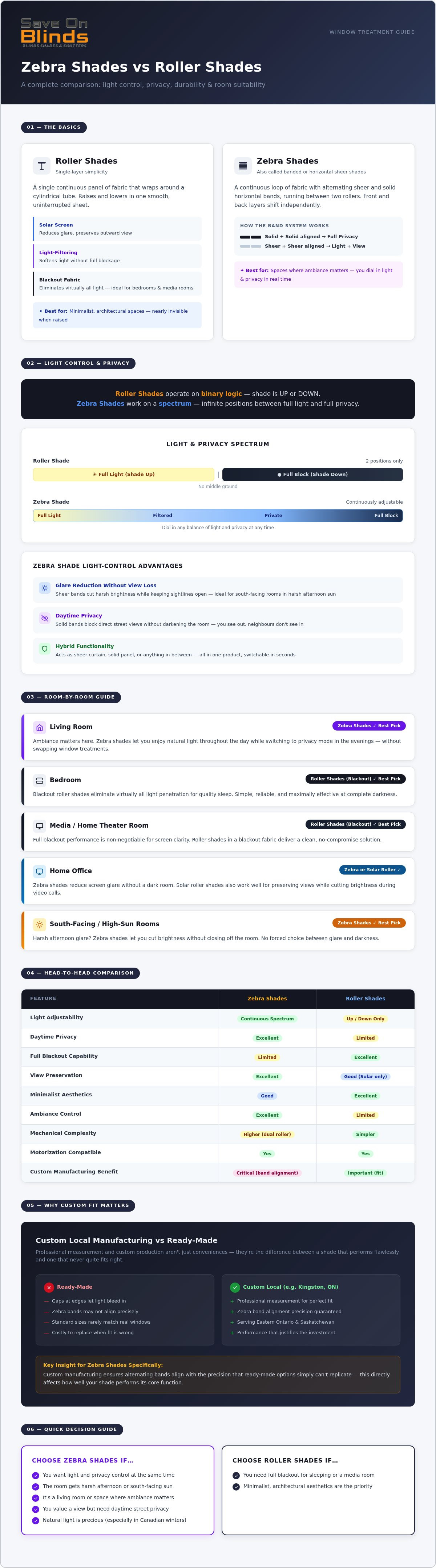
A roller shade is exactly what it sounds like: a single continuous panel of fabric that wraps around a cylindrical tube mounted above your window. When you raise the shade, the fabric rolls up cleanly onto that tube. When you lower it, it unrolls in one smooth, uninterrupted sheet.
That simplicity is genuinely useful. Because there's only one layer of material, roller shades can be manufactured in a wide range of fabrics without adding mechanical complexity:
- Solar screen fabrics that reduce glare while preserving your outward view
- Light-filtering materials that soften incoming light without blocking it entirely
- Blackout fabrics that eliminate virtually all light penetration for bedrooms or media rooms
For homeowners who prefer a clean, architectural look, roller shades are a natural fit. When raised, the fabric disappears into a slim profile near the ceiling, making the window treatment almost invisible. It's the definition of a minimalist window solution.
The Mechanics of Zebra Shades
Zebra shades, also called banded shades or horizontal sheer shades, work on a completely different principle. Instead of a single panel, they use a continuous loop of fabric woven with alternating horizontal bands: one sheer, one solid. That looped fabric runs between two rollers, which means the front and back layers can shift independently of each other.
Here's where the design becomes genuinely clever. When the solid bands on the front layer align with the solid bands on the back layer, you get a fully opaque, private configuration. Shift the layers so the sheer bands align instead, and natural light filters through while you retain a soft, diffused view to the outside. The transition between these two states is smooth and precise.
This adjustability is what separates zebra shades from a standard roller shade in a meaningful way. You're not choosing between "shade up" or "shade down." You're dialing in exactly the balance of light and privacy your room needs at any given moment, which makes them a standout option for Canadian living spaces where natural light is precious and privacy still matters. Custom-manufactured zebra shades, like those made locally in Kingston, Ontario, ensure those alternating bands align with precision that ready-made options simply can't replicate.
Light Control and Privacy: A Side-by-Side Comparison
Light control is where the zebra shades vs roller shades conversation gets genuinely interesting, because these two styles don't just perform differently — they solve different problems entirely. Roller shades operate on a binary logic: the shade is either up or it's down. Zebra shades work on a spectrum. Understanding that distinction will tell you more about which option belongs in your home than any aesthetic comparison ever could.
Dynamic Light Filtering with Zebra Shades
The alternating sheer and solid bands in a zebra shade give you something a standard roller shade simply can't offer: a middle ground. Slide the bands into the open position and soft, diffused daylight fills your room while you keep a clear view to your backyard or street. Shift them toward the closed position and those solid bands stack together, blocking direct sightlines without plunging the room into darkness.
This makes zebra shades a genuine hybrid between a blind and a shade. You get the view-preserving quality of a sheer curtain, the privacy of a solid panel, and the ability to switch between them in seconds. For a south-facing living room catching harsh afternoon sun, that kind of precision matters. You're not forced to choose between glare and a dark room — you simply adjust.
Key light-control advantages zebra shades deliver:
- Glare reduction without view loss — sheer bands cut harsh brightness while keeping your sightlines open
- Daytime privacy — solid bands block direct views from the street without requiring the shade to be fully lowered
- Ambient light shaping — ideal for living spaces, dining rooms, and home offices where atmosphere matters throughout the day
Total Light Blockage with Roller Shades
For bedrooms, nurseries, and dedicated media rooms, blackout roller blinds remain the gold standard for a reason. A single layer of blackout fabric, when properly fitted, creates a near-total barrier against incoming light. There's no band alignment to manage, no layering system to adjust. You lower the shade and the room goes dark.
That said, performance depends heavily on fit. Even the densest blackout fabric loses its effectiveness if light bleeds around the edges of an improperly sized shade. Side channels and professional measurement close those gaps, which is exactly why custom manufacturing to your window's exact dimensions isn't a luxury — it's a necessity for genuine blackout results.
Fabric opacity also shapes how both styles perform at night. A light-filtering roller shade that looks perfectly private during the day can become a backlit silhouette screen after dark, when interior lighting reverses the visibility equation. Zebra shades in the closed position offer stronger nighttime privacy than a light-filtering roller at the same price point, making them a smarter choice for ground-floor rooms where evening privacy is a real concern.
If you're unsure which fabric weight or configuration suits your specific rooms, a consultation with a local window treatment specialist can take the guesswork out of the decision entirely.
Room-by-Room Suitability: Which Shade Goes Where?
Knowing how zebra shades and roller shades perform in general is one thing. Knowing which one belongs in your kitchen versus your bedroom is where that knowledge actually becomes useful. The right shade for one room can be completely wrong for another, and matching the product to the space is where most homeowners either get it right or spend money fixing a mistake.
Living Rooms
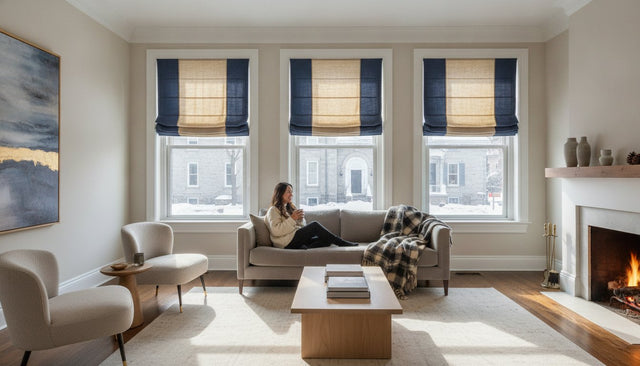
Zebra shades were practically designed for living rooms. The ability to filter afternoon light without closing off your view creates exactly the kind of layered, sophisticated atmosphere that a single roller shade can't replicate. When solid bands align, you get privacy without darkness. When sheer bands open up, the room feels connected to the outdoors. That visual flexibility also adds a design element on its own: the horizontal banding creates clean, architectural lines that elevate a space without competing with your furniture or artwork.
Kitchens
Kitchens are a different story. Steam, cooking grease, and humidity are the enemies of any fabric treatment, and roller shades win here on durability. A wipe-clean solar or light-filtering roller shade handles the demands of a kitchen environment far better than the layered fabric construction of a zebra shade. Keep it simple, keep it practical.
Bedrooms
For bedrooms, the zebra shades vs roller shades question comes down to one thing: how dark do you actually need it? If you're a light sleeper, shift worker, or parent of a young child, a blackout roller shade with professional measurement and proper edge coverage is the clear answer. If you want the option to filter morning light gently rather than block it completely, a room-darkening zebra shade gives you that flexibility. Neither is universally better; your sleep habits decide.
Home Offices
Screen glare is a genuine productivity problem, and adjustable zebra shades address it better than a fixed roller. You can shift the bands throughout the day as the sun moves, reducing glare on your monitor without switching between fully open and fully closed. That kind of precise, on-the-fly adjustment is something a standard roller simply doesn't offer.
The Best Choice for Large Windows and Patio Doors
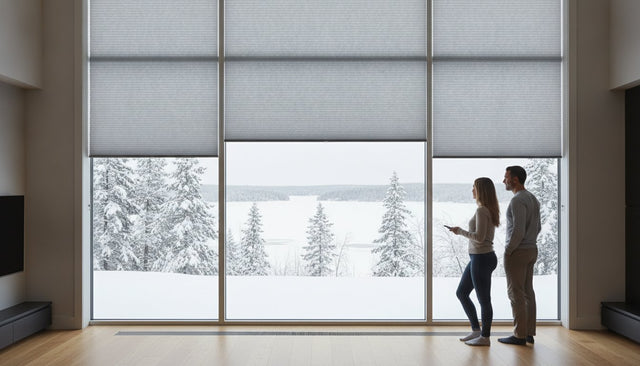
Wide windows and patio doors introduce a challenge that smaller openings don't: weight and visual scale. A wide roller shade can become difficult to operate smoothly if the fabric weight isn't matched to the mechanism, which is exactly why professional measurement and locally manufactured custom sizing matter for Kingston homes with larger openings. Zebra shades on floor-to-ceiling windows make a bold statement, but the band scale needs to be proportional to the frame. Oversized bands on a narrow floor-to-ceiling window can feel visually heavy rather than elegant. For patio door configurations with unusual dimensions or hardware conflicts, working with a custom blinds near me specialist ensures the treatment fits the opening without compromising how the door actually functions.
Small Windows and Tight Spaces
In powder rooms and narrow windows, the slim rolled profile of a lowered roller shade is a genuine advantage. It doesn't crowd the frame, it doesn't add visual noise, and it disappears completely when raised. Zebra shades in a very small frame can look busy, with the banding pattern drawing more attention than the window itself warrants. In open-concept floor plans, the smarter move is often to anchor one style as the dominant choice across shared sightlines, then introduce the other in enclosed rooms where it performs best. Consistency across connected spaces reads as intentional design rather than indecision.
Durability, Maintenance, and Motorization in 2026
Choosing between zebra shades vs roller shades isn't just a decision about today's aesthetics. It's a commitment to a product you'll live with for years, clean regularly, and potentially upgrade as your home evolves. Durability and maintenance are where that long-term thinking pays off or costs you.
Roller shades have a clear maintenance advantage. A single layer of fabric means a single surface to clean. Most high-quality roller fabrics can be spot-cleaned with a damp cloth and mild detergent, and solar or vinyl-coated materials handle kitchen humidity and cooking residue without absorbing odors or staining deeply. The mechanism is simple, and fewer moving parts mean fewer points of failure over time.
Zebra shades require a more careful approach. Dust settles between the alternating fabric layers, and a standard wipe-down doesn't reach the interior surfaces. A soft-bristle brush attachment on a low-suction vacuum is the most effective routine maintenance tool. For spot cleaning, work gently on one layer at a time using a barely damp cloth, and avoid saturating the fabric. The dual-layer construction means moisture trapped between bands can cause mildew in humid rooms if not dried properly.
Fabric longevity is another honest consideration. The continuous shifting of two fabric layers in a zebra shade creates friction at the band edges over time. In lower-quality products, this eventually causes fraying along the transition zones. Locally manufactured zebra shades built to precise tolerances reduce this risk significantly, because the band alignment is tighter and the fabric tension is calibrated correctly from the start. A poorly made shade will show wear within a few years. A well-made one won't.
Canadian UV exposure is a real factor that most guides ignore entirely. Extended sun exposure through south- and west-facing windows accelerates fabric fading in both shade types. When selecting fabric, look for UV-resistant treatments or tightly woven materials rated for sun-facing installations. This is especially relevant in Saskatchewan, where summer sun intensity is higher and windows receive prolonged direct exposure.
Smart Home Integration and Motorization
Motorized window coverings have moved from luxury to practical standard in 2026, and both shade types support motorization well. For zebra shades, motorization eliminates the band-alignment guesswork entirely: program your preferred open and closed positions once, and the shade returns to them precisely every time. For roller shades, scheduled automation means blackout fabrics in bedrooms lower automatically at bedtime and raise with your morning alarm.
Battery-powered motors suit retrofits and rental properties where hardwiring isn't practical. Hardwired motors are the better long-term investment for new builds, offering more reliable performance and eliminating battery replacement entirely. In Regina winters, scheduling shades to lower automatically during peak cold hours adds a measurable layer of insulation, reducing heat loss through glass without any manual effort.
Cordless and motorized options also eliminate looped cords entirely, which is the current safety standard for homes with young children and pets. If you're replacing older shades with traditional cord mechanisms, this upgrade isn't optional; it's the right call.
Long-Term Maintenance Tips
- Zebra shades: Vacuum gently every four to six weeks using a brush attachment. Avoid steam cleaning, which can distort the fabric layers. For stubborn spots, blot rather than rub.
- Roller shades: Wipe solar and vinyl fabrics with a damp cloth as needed. For fabric rollers, use a dry brush for dust and spot-clean with a diluted mild soap solution.
- Motorized mechanisms: Keep tracks and tubes free of dust buildup. If a motor stops responding to commands, check the power source before assuming mechanical failure. Most issues are connection-related, not motor failure.
- Professional adjustment: If a zebra shade's bands stop aligning cleanly or a roller shade develops an uneven roll, call a professional before attempting to rethread or rebalance the mechanism yourself. Forcing a misaligned shade typically makes the problem worse.
Proper care extends the life of any window treatment significantly. If you're unsure which fabric or motor configuration suits your specific rooms and usage patterns, book a consultation with Save On Blinds to get a recommendation built around your home's actual needs.
Why Custom Local Manufacturing Wins: The Save On Blinds Difference
Most window treatment guides stop at product comparison and leave you to figure out the rest on your own. That gap between choosing a shade and having one that actually performs is where the real difference lies, and it's where local custom manufacturing earns its value. When you're weighing zebra shades vs roller shades, the quality of the product matters, but so does the precision of how it's built and installed.
Save On Blinds manufactures custom shades locally in Kingston, Ontario. That's not a marketing detail; it's a quality control mechanism. When a shade is built to your window's exact dimensions in the same region it's installed, the tolerances are tighter, the lead times are shorter, and there's no overseas shipping chain introducing variability before the product ever reaches your home. Factory-direct pricing also removes the retail markup that big-box stores build into every unit, so you're paying for the product, not the distribution chain.
That local commitment extends across Eastern Ontario, including Brockville, Belleville, and Perth, and into Saskatchewan. Supporting a regional manufacturer means your investment stays in the community rather than funding a distant warehouse operation.
For zebra shades specifically, local manufacturing isn't just a preference; it's a functional requirement. The alternating band system only looks right when the fabric tension and band width are calibrated to the exact opening size. An eighth of an inch error in width throws the band alignment off-center, and that misalignment is visible every single day. Ready-made options can't account for the slight variations that exist between windows in the same room, let alone across an older Ontario home where no two frames are perfectly identical.
The Precision of Professional Installation
Getting the shade built correctly is only half the job. Installation determines whether zebra bands line up cleanly across multiple windows in a shared sightline, whether a heavy motorized roller sits level in its brackets, and whether the mounting hardware holds securely in the plaster or drywall common in older Eastern Ontario homes. A shade that's even slightly off-level draws the eye immediately, undermining the clean aesthetic you chose it for. Professional installation eliminates that risk and comes with the assurance that the fit is guaranteed.
Your Local Consultation Advantage
Choosing fabric from a website photo is a gamble. Seeing samples in your home's actual light, whether that's the flat northern exposure of a Kingston living room or the intense prairie sun of a Saskatoon window, is how you make a confident decision. Save On Blinds offers in-home and virtual consultations that bring that experience directly to you.
The journey is straightforward:
- Consultation: Discuss your rooms, light needs, and style preferences with an expert who understands the specific demands of Canadian homes
- Measurement: Professional measurement to exact dimensions, eliminating the guesswork that causes fit problems
- Custom manufacturing: Your shades are built locally to those precise specs
- Installation: Expert installation with proper leveling, secure mounting, and a finished result that performs exactly as intended
That end-to-end process is what separates a window treatment that looks right from one that works right. Explore your options for custom blinds Kingston Ontario homeowners trust, and book a consultation to start the conversation with a team that already knows your region, your climate, and your home.
Make the Right Choice for Your Home, Starting Today
The zebra shades vs roller shades decision isn't complicated once you know what each style is actually built to do. Zebra shades give you adjustable light and privacy in a single treatment, making them the smarter choice for living spaces where ambiance shifts throughout the day. Roller shades deliver clean simplicity and genuine blackout performance where total darkness is the priority. Neither is universally better; the right answer lives in your specific rooms, your light conditions, and how you actually use your home.
What makes the difference between a shade that looks right and one that works right is precision: custom manufacturing to your exact dimensions, professional installation, and a consultation with someone who understands Canadian homes. Save On Blinds delivers all three, with every shade locally manufactured in Kingston, Ontario, and installed by experts who get the fit right the first time.
You don't have to figure this out alone. Book your free in-home consultation today and get a recommendation built around your home's actual needs. The right window treatment is closer than you think.
Frequently Asked Questions About Zebra Shades vs Roller Shades
Are zebra shades more expensive than roller shades?
Zebra shades typically cost more than basic roller shades because of their dual-layer fabric construction and more complex mechanism. That said, the price gap narrows considerably when you compare zebra shades to premium roller shades in blackout or motorized configurations. The more useful comparison is value per function: if you need adjustable light and privacy in one treatment, a zebra shade often replaces what would otherwise require two separate window coverings.
Can you see through zebra shades at night when the lights are on?
Yes, this is a real concern. When your interior lights are on after dark, the visibility equation reverses: light travels outward through sheer fabrics more easily than it travels inward. With zebra shades in the open band position, people outside can see silhouettes through the sheer sections. Shifting the solid bands into the closed position resolves this completely. For ground-floor rooms, make closing the bands part of your evening routine.
Do zebra shades provide full blackout for a bedroom?
Standard zebra shades don't deliver true blackout performance. Even with solid bands fully aligned, the fabric construction allows some light to filter through, and the edges of the shade can let light bleed around the frame. If genuine darkness is your priority for sleep, a blackout roller shade with professional measurement and proper edge coverage is the right choice. Room-darkening zebra shades are a reasonable middle ground if you want morning light control without total darkness.
Which is easier to clean: zebra or roller shades?
Roller shades are easier to maintain. A single fabric layer means one surface to wipe down, and many roller fabrics are treated for moisture resistance, making spot cleaning straightforward. Zebra shades require more care because dust settles between the alternating layers where a cloth can't easily reach. A low-suction vacuum with a soft brush attachment handles routine cleaning effectively, but the process takes more time and attention than a quick wipe of a roller shade.
Are zebra shades out of style in 2026?
Not at all. In the zebra shades vs roller shades conversation, zebra shades have held their ground as a design choice precisely because they solve a practical problem elegantly. The horizontal banding adds architectural interest without visual clutter, which fits naturally into the clean-lined interiors that remain popular in 2026. Their hybrid light-and-privacy functionality keeps them relevant beyond trend cycles. A well-chosen zebra shade in a quality fabric reads as timeless rather than fashionable.
Can I motorize my existing roller or zebra shades?
Retrofitting motorization onto existing shades depends entirely on the original mechanism and hardware. Many shades aren't built to accommodate a motor after the fact without replacing the headrail assembly. In most cases, motorization is most reliably added during the manufacturing stage, where the motor is integrated into the tube or mechanism from the start. If motorization is a priority, the most practical path is ordering new custom shades with the motor included rather than attempting a retrofit.
Do zebra shades help with home insulation in the winter?
Zebra shades offer modest insulation value compared to cellular or honeycomb shades, which are specifically engineered for thermal performance. The dual fabric layers do create a small air pocket that reduces some heat transfer through glass, but it's not a significant insulating effect. For Canadian winters, especially in Saskatchewan where temperatures drop sharply, pairing zebra shades with heavier drapery or choosing honeycomb shades for your most exposed windows will deliver meaningfully better energy retention.
How do I choose the right band size for my zebra shades?
Band size should be proportional to your window dimensions. Wider, taller windows suit larger bands that maintain visual balance without looking cluttered. Narrow windows or smaller frames look better with tighter, more refined banding that doesn't overwhelm the opening. This is one area where a professional consultation genuinely matters: seeing fabric samples scaled against your actual window, in your home's specific light, gives you a far more accurate sense of proportion than any online photo can. A specialist can match band width to your window dimensions precisely.